


T: +86-19511798062
E: sales@honestflex.com
E: sales@honestflex.com
Licang District, Qingdao, Shandong, China
Views: 0 Author: Site Editor Publish Time: 2026-06-29 Origin: Site


When designing or maintaining fluid power systems, selecting the correct components is essential for efficiency, safety, and longevity. Among the most critical decisions is choosing the right type of Hydraulic Hose for your specific application. The debate between braided and spiral hydraulic hoses is a common one, as each design offers distinct advantages and limitations depending on the operating environment, pressure requirements, and physical constraints of the machinery involved.
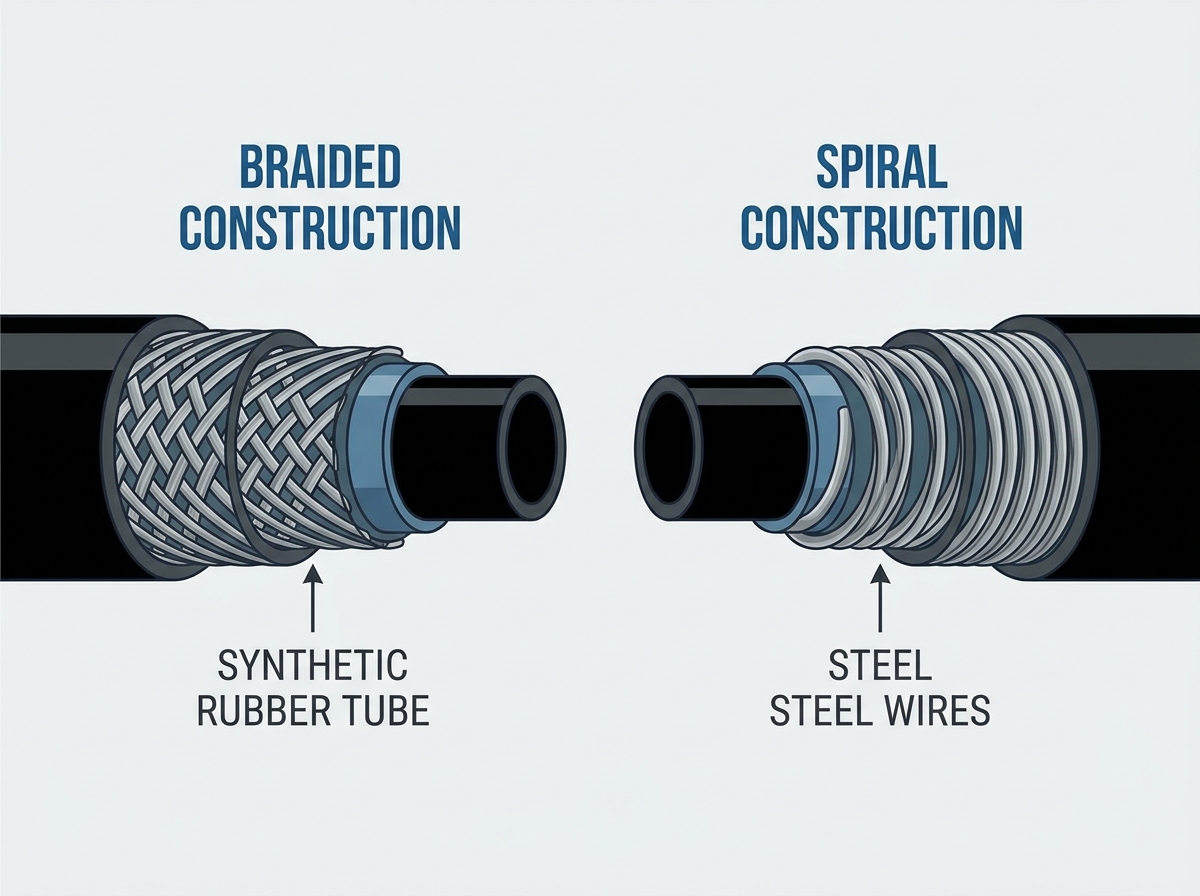
Understanding the construction differences between braided and spiral hydraulic hoses is key to optimizing system performance.
Fluid power systems rely on hoses to transmit force through pressurized liquids, typically petroleum-based or water-based fluids. The structural integrity of these hoses determines how well they can withstand internal pressure, external abrasion, and environmental degradation. To make an informed decision, engineers and maintenance professionals must understand the fundamental differences in construction, performance characteristics, and ideal use cases for both braided and spiral designs.
Every industrial hose designed for high-pressure fluid transmission consists of three primary layers: the inner tube, the reinforcement layer, and the outer cover. The inner tube must be compatible with the fluid being carried, ensuring it does not degrade or contaminate the system. The outer cover protects the hose from external factors such as abrasion, oil, weathering, and corrosion. However, it is the middle layer—the reinforcement—that dictates the hose's pressure rating, flexibility, and overall durability.
The reinforcement layer is typically made of high-tensile steel wire or synthetic fibers. The way this wire is applied to the inner tube defines whether the hose is classified as braided or spiral. This structural difference fundamentally alters how the hose behaves under pressure, how it handles pressure impulses (spikes), and how tightly it can be bent during installation.
A braided hose features one or more layers of high-tensile steel wire woven in a crisscross pattern around the inner tube. This overlapping, interwoven design provides a balance of strength and flexibility, making braided hoses a versatile choice for a wide range of general industrial and hydraulic applications.
The braided construction allows the hose to bend more easily compared to spiral designs. The interwoven wires can shift slightly relative to one another when the hose is bent, providing a tighter minimum bending radius. This flexibility is crucial in compact machinery or complex routing scenarios where space is limited. Braided hoses are typically available in single-wire (1SN/1AT) or double-wire (2SN/2AT) configurations, with the latter offering higher pressure ratings.
While braided hoses are highly flexible, their interwoven design has limitations when it comes to extreme high pressures and severe pressure impulses. Where the wires cross over one another, friction can occur during pressure spikes. Over time, in systems with constant, severe pressure fluctuations, this friction can lead to wire fatigue and eventual hose failure. Therefore, braided hoses are generally best suited for low to medium-high pressure applications with moderate impulse cycles.
In contrast to the braided design, a spiral hose features multiple layers of high-tensile steel wire wrapped in alternating parallel directions around the inner tube. Instead of weaving over and under each other, the wires lay flat in a helical pattern. Most spiral hoses utilize four or six layers of wire to achieve their high pressure ratings.
The primary advantage of spiral construction is its exceptional strength and resistance to pressure impulses. Because the wires do not cross over one another, there is no internal friction between the wires during pressure spikes. This makes spiral hoses incredibly robust and capable of handling extremely high operating pressures and severe, continuous impulse cycles without premature fatigue.
The trade-off for this immense strength is a significant reduction in flexibility. The multiple, densely packed layers of parallel wire make spiral hoses much stiffer than their braided counterparts. They have a larger minimum bending radius and require more effort to route and install, especially in tight spaces. For heavy machinery operating at extreme pressures, however, this stiffness is a necessary compromise for safety and reliability.
To determine which type of hose is better for a specific application, it is helpful to compare them across several critical performance metrics.
As a general rule, spiral hoses are designed for higher operating pressures than braided hoses. While high-quality braided hoses can handle substantial pressure, heavy-duty applications such as large excavators, mining equipment, and high-tonnage hydraulic presses typically require the superior burst strength of a four- or six-wire spiral hose.
Impulse life refers to the number of pressure cycles (spikes from low to high pressure) a hose can withstand before failing. Spiral hoses vastly outperform braided hoses in this metric due to the lack of wire crossover friction. If a system experiences frequent, aggressive pressure surges, a spiral hose is the safer and more durable choice.
Braided hoses win in scenarios requiring tight routing. Their superior flexibility and smaller bending radii make them easier to install in compact agricultural machinery, forklifts, and general manufacturing equipment. Forcing a spiral hose into a tight bend that exceeds its minimum radius can cause the wire layers to separate, leading to catastrophic failure.
To illustrate the practical application of braided technology, we can look at a specific industrial standard product. The Honestflex DIN EN853 2SN / SAE 100R2AT Hydraulic Hose is a prime example of a high-quality, double-wire braided design intended for reliable performance in demanding environments.
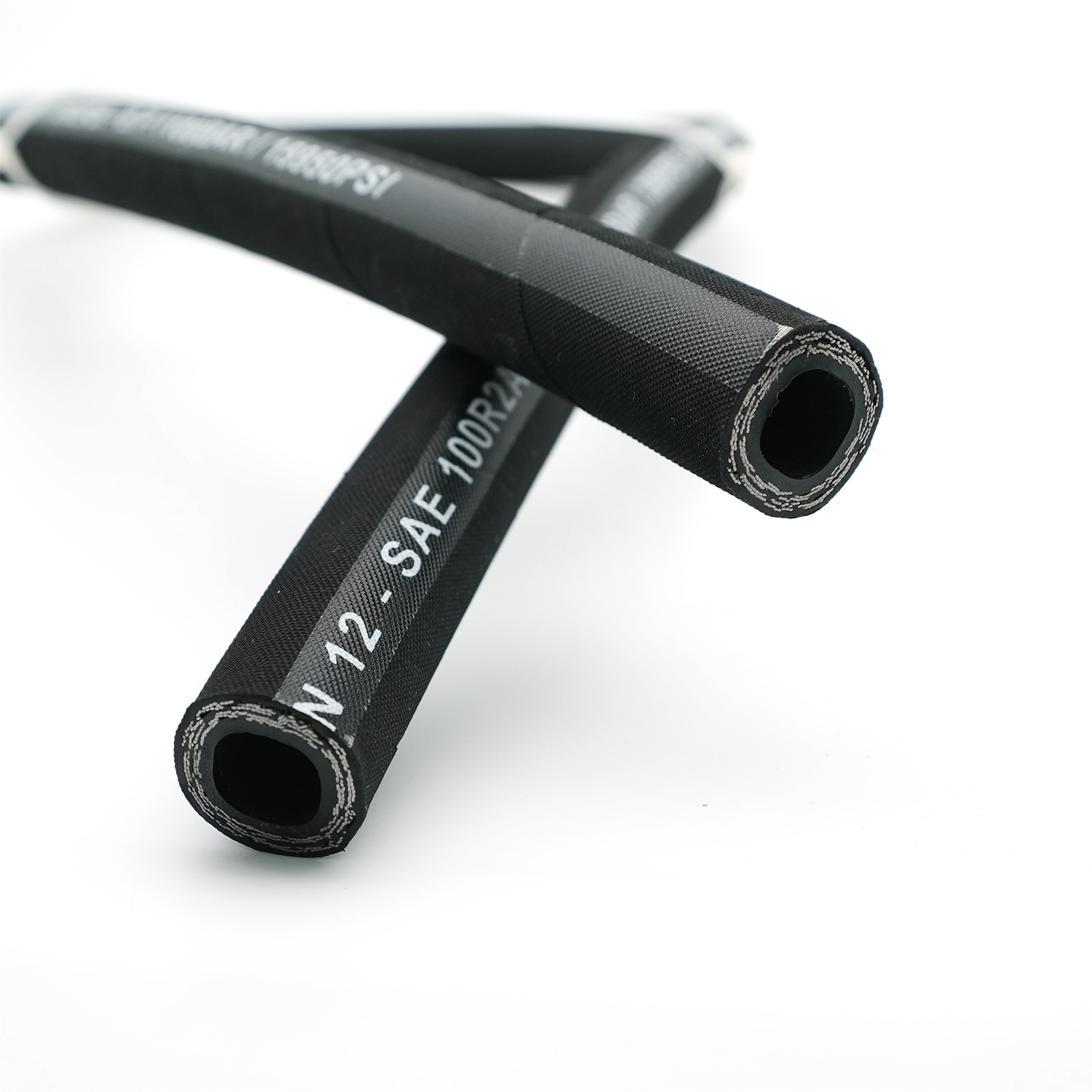
This specific hose is constructed with a black oil-resistant synthetic rubber inner tube, ensuring compatibility with systems utilizing both petroleum-based and water-based fluids. The reinforcement consists of two braids of high-tensile steel wire, providing the structural strength necessary for medium to high-pressure applications. The outer layer features a black synthetic rubber cover designed to resist oil, corrosion, and abrasion, protecting the internal reinforcement from harsh external conditions.
The hose comes equipped with male NPT (National Pipe Thread) fittings at both ends, facilitating secure attachment to system components. It is available in 11 metric sizes ranging from 5mm to 51mm (SAE Dash 3 to 30), offering versatility for various flow requirements. The working pressures for this hose range from 8 Mpa (1160 Psi) for the largest 51mm size up to 41.5 Mpa (6018 Psi) for the smallest 5mm size. Correspondingly, burst pressures range from 32 Mpa to 165 Mpa depending on the hose size. Reflecting the flexibility inherent in braided designs, the bending radii range from 90mm to 630mm across the different sizes.
Meeting rigorous industry standards, this product complies with both DIN EN853 2SN and SAE 100R2AT specifications. It is explicitly suited for general industrial and hydraulic applications where a balance of flexibility, pressure resistance, and durability is required.
The decision between braided and spiral construction ultimately depends on the specific demands of the machinery and the operating environment. There is no single "better" option; rather, there is a more appropriate option for a given set of conditions.
Braided hoses are the ideal choice for applications where flexibility and ease of routing are paramount, and where operating pressures and impulse cycles fall within moderate ranges. They are commonly found in agricultural equipment, material handling machinery, light construction equipment, and general manufacturing fluid power systems. Their ability to navigate tight spaces without compromising flow makes them indispensable in compact designs.
Spiral hoses are necessary when dealing with extreme high pressures and severe, continuous pressure impulses. Heavy construction equipment, mining machinery, large-scale injection molding machines, and heavy-duty industrial presses rely on the robust construction of spiral hoses to prevent catastrophic failure under immense stress. When safety and durability under extreme conditions outweigh the need for flexibility, spiral is the mandatory choice.
Regardless of whether a braided or spiral design is chosen, proper maintenance and regular inspection are critical for ensuring system safety and maximizing the lifespan of the hose assembly.
Regular visual inspections should be conducted to check for signs of wear on the outer cover. Abrasions, cuts, or cracks that expose the wire reinforcement are immediate causes for replacement, as exposed wire will quickly corrode and weaken the hose structure. Additionally, inspect the fittings for signs of leakage, slippage, or corrosion.
Proper installation practices significantly impact hose longevity. Ensure that hoses are not twisted during installation, as twisting drastically reduces pressure capacity and impulse life. Use appropriate clamps and guards to prevent hoses from rubbing against each other or against moving machine parts. Always adhere to the manufacturer's specified minimum bending radius; forcing a hose into a tighter bend will cause premature failure, especially in stiffer spiral designs.
When selecting a hose, it is crucial to ensure it meets recognized industry standards, such as those set by SAE (Society of Automotive Engineers), DIN (Deutsches Institut für Normung), or EN (European Norm). These standards dictate the minimum performance requirements for dimensions, pressure ratings, impulse life, and material compatibility, ensuring that the hose will perform safely and reliably in its intended application.
Standards like SAE 100R2AT or DIN EN853 2SN provide a universal language for engineers and technicians. They specify that a hose is a two-wire braided design meeting specific performance criteria. Understanding these designations allows for accurate replacement and system design, ensuring that components are correctly matched to the system's operational demands.
The Honestflex DIN EN853 2SN / SAE 100R2AT hose provides a reliable solution for general industrial fluid power systems, featuring an oil-resistant synthetic rubber inner tube compatible with petroleum and water-based fluids, reinforced by two braids of high-tensile steel wire for strong structural integrity. With a durable synthetic rubber cover resisting oil, corrosion, and abrasion, and equipped with secure male NPT fittings, it offers working pressures up to 41.5 Mpa and bending radii as tight as 90mm across its 11 available sizes (5mm to 51mm), making it highly suitable for applications requiring certified, flexible, and robust medium-to-high pressure fluid transmission.
