


T: +86-19511798062
E: sales@honestflex.com
E: sales@honestflex.com
Licang District, Qingdao, Shandong, China
Views: 0 Author: Site Editor Publish Time: 2026-10-26 Origin: Site


Choosing the right fuel suction and discharge hose is essential for safe and efficient tanker truck operations. The hose must handle the fuel being transferred and withstand the pressure and vacuum conditions of the system.
A suitable hose also needs the correct inner diameter, length, reinforcement, and end connections. These factors affect flow performance, handling, and service life.
This guide explains how to choose a fuel suction and discharge hose for tanker trucks. It covers fuel compatibility, hose construction, pressure and vacuum ratings, sizing, fittings, safety, and maintenance.
Table of Contents
Before selecting a hose, identify the exact liquid to be transferred. Different petroleum products and fuel blends may require different hose materials.
Gasoline and diesel are common fuels in tanker truck operations. Their compatibility with the hose depends on the inner tube material and the fuel composition.
NBR rubber is commonly used for petroleum transfer hoses because of its resistance to many oil-based products. However, buyers should check the manufacturer's compatibility data before selecting a hose.
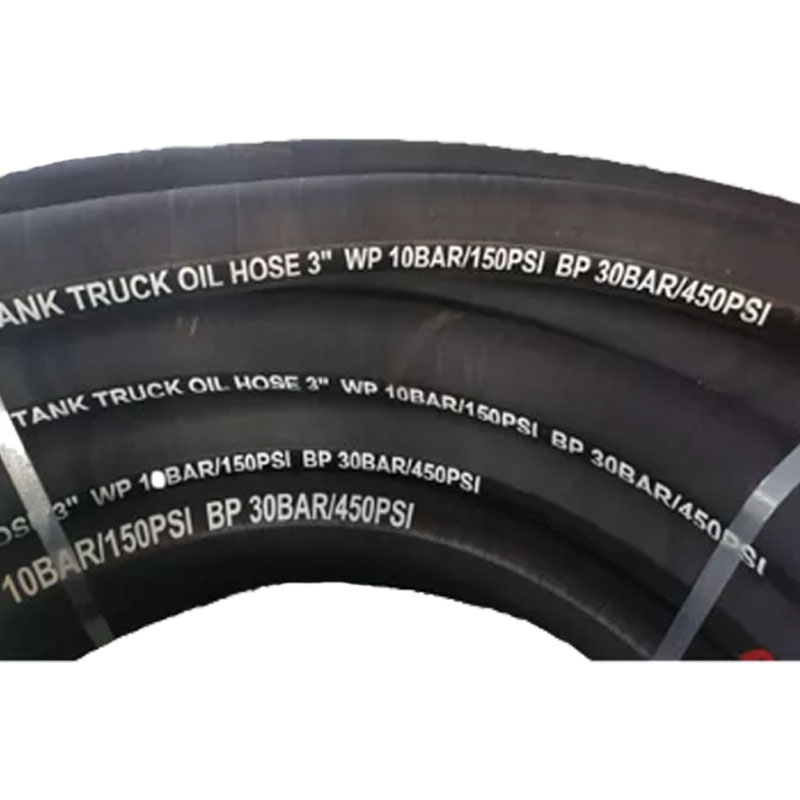
For example, the Honestflex Tank Truck Oil Hose uses a smooth NBR inner tube. The product is designed for petroleum fuels with aromatic content up to 50%.
Alternative fuels require additional compatibility checks. Biodiesel blends and ethanol-containing fuels can affect rubber materials differently from conventional gasoline and diesel.
Do not assume that a standard NBR hose is suitable for every blend or concentration. Confirm the exact fuel composition and ask the hose manufacturer to verify compatibility.
For high-ethanol blends or other specialty fuels, use a hose specifically approved for the intended medium.
Some tanker truck systems transfer fuel oils, lubricants, crude oil, or other petroleum-based liquids.
Check the inner tube's compatibility with the actual product. Consider additives, aromatic content, operating temperature, and exposure time before making a selection.
A fuel suction and discharge hose needs a suitable inner tube, reinforcement layer, and outer cover. Each component has a different function.
The inner tube contacts the transferred liquid directly. It must resist swelling, softening, and deterioration caused by the fuel.
NBR is widely used in oil and fuel transfer hoses. Its suitability still depends on the specific fuel composition and operating conditions.
The reinforcement layer provides strength and helps the hose maintain its shape.
A tanker truck suction and discharge hose commonly uses:
Synthetic textile fabric: Provides tensile strength and supports pressure resistance.
Steel wire helix: Helps the hose resist collapse under vacuum conditions.
Anti-static wire, where specified: Supports electrical continuity through the hose assembly when correctly connected and maintained.
The steel wire helix is particularly important when the hose operates under negative pressure. A discharge-only hose should not be used on a suction line unless the manufacturer confirms its vacuum rating.
The Honestflex Tank Truck Oil Hose combines high-strength synthetic fabric, a steel wire helix, and an anti-static wire for tanker truck fuel transfer applications.
The outer cover protects the reinforcement from external damage.
For tanker truck operations, the cover may need resistance to oil, fuel, weathering, and abrasion. A corrugated cover may also be available when additional flexibility is required.
Choose the cover according to the actual working environment, including outdoor exposure, contact with rough surfaces, and handling frequency.
Pressure and vacuum ratings are essential when choosing a fuel suction and discharge hose.
Working pressure is the maximum pressure specified for normal hose operation. The hose assembly must be suitable for the highest pressure expected in the system.
Check the pump's operating pressure, possible pressure surges, and the ratings of the fittings and other connected components.
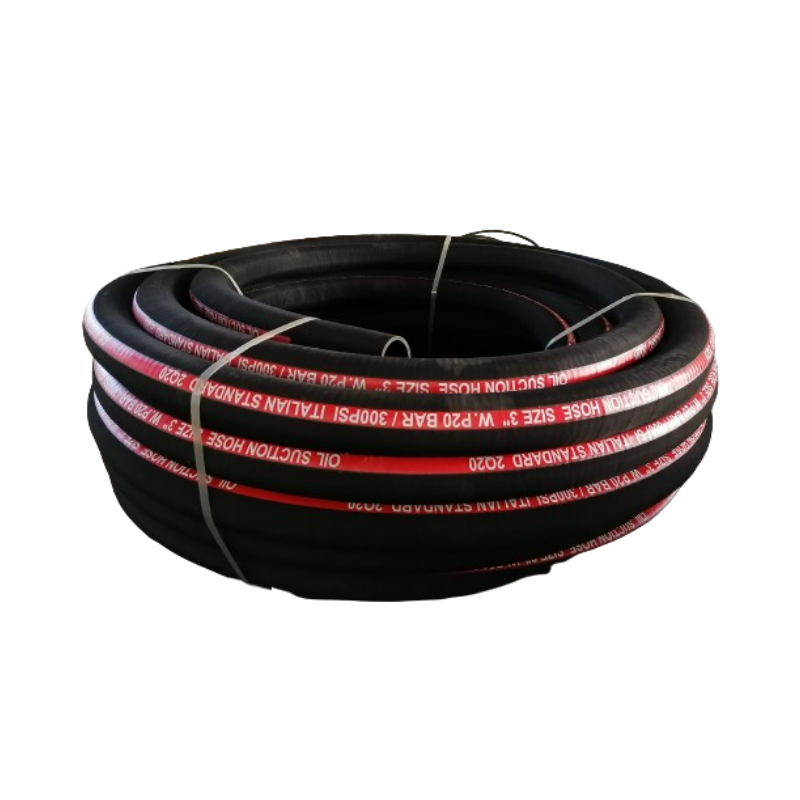
For reference, the Honestflex Tank Truck Oil Hose product page lists a nominal working pressure of 10 bar (150 PSI) for its 2–6 inch sizes. Always confirm the current specification for the exact model and size before ordering.
A suction hose must resist negative pressure without collapsing.
When a pump draws fuel through the hose, atmospheric pressure outside the hose can cause an unsuitable hose to flatten. This restricts flow and may interrupt the transfer process.
A steel wire helix helps support the hose wall under vacuum conditions. However, the presence of a wire helix alone does not confirm a particular vacuum rating.
Check the manufacturer's stated vacuum limit and make sure it meets the system requirement.
Working pressure and burst pressure describe different limits.
Working pressure: The specified pressure for normal operation.
Burst pressure: The pressure at which the hose is expected to fail under a controlled test.
Do not use burst pressure as the operating limit. Select the hose based on its rated working pressure and the complete assembly requirements.
Correct hose sizing helps maintain the required flow rate and reduces unnecessary pressure loss.
The inner diameter determines the available flow area. A hose that is too small can increase fluid velocity and pressure loss. It may also place additional demands on the pump.
A hose that is unnecessarily large can increase weight, cost, and handling difficulty.
To select the correct diameter, consider:
Required transfer flow rate.
Pump capacity and operating conditions.
Suction or discharge service.
Pipeline length and routing.
Connection and port sizes.
Use the pump manufacturer's flow data and the hose supplier's sizing guidance. Avoid relying on a generic flow table without checking the actual system conditions.
Measure the distance between the connection points along the intended hose route.
Allow enough length for normal movement and smooth bends. Do not stretch the hose tightly between connections or leave excessive slack that creates handling risks.
A hose that is too short can place tension on fittings. An unnecessarily long hose can increase pressure loss, weight, and handling difficulty.
Every hose has a specified minimum bend radius. Bending below this limit can damage the reinforcement or restrict the flow path.
Route the hose without sharp bends, twisting, or kinking. Check the manufacturer's bend radius for the selected diameter before installation.
The hose and its end connections must work as one assembly. Incorrect fittings can cause leakage, pressure loss, or mechanical damage.
Tanker truck systems may use different connection arrangements depending on the truck, pump, and receiving equipment.
Before ordering, confirm:
Connection standard and size.
Thread type, if threaded connections are used.
Flange dimensions, if flanged connections are required.
Coupling type and locking arrangement.
Required sealing materials.
Do not assume that two fittings are compatible because they have similar dimensions. For example, BSP and NPT threads are different standards and should not be mixed.
Fitting materials should be compatible with the transferred fuel and the operating environment.
Consider corrosion resistance, mechanical strength, temperature, and connection design. The selected fitting must also be suitable for the hose's working pressure.
A hose's performance depends on more than the rubber tube. The coupling, attachment method, sealing components, and assembly quality also matter.
Confirm that the hose and fittings are designed to work together. Follow the manufacturer's assembly and inspection instructions.
Fuel transfer can generate static electricity. If electrical charges are not controlled, they may create an ignition risk in a flammable atmosphere.
Some fuel transfer hoses include conductive rubber or anti-static wires. These features can help provide an electrical path through the hose assembly.
The Honestflex Tank Truck Oil Hose product description lists an anti-static wire in its reinforcement structure.
However, an anti-static wire alone does not replace correct system bonding and grounding. The complete transfer setup must follow the applicable safety procedures.
Where electrical continuity is required, inspect the hose assembly and verify continuity using the approved test procedure.
Check the condition of the wire, fittings, and connection points. Do not use a damaged assembly when the required electrical path cannot be confirmed.
Hose standards depend on the application, product type, and target market. A standard for a fuel dispenser hose may not apply to a tanker truck suction and discharge hose.
Before purchasing, confirm which standards, certifications, and transport regulations apply to the specific operation. Request supporting documentation from the manufacturer when compliance is required.
Regular inspection helps identify damage before it causes leakage or operational problems.
Inspect the hose before use and at the intervals required by the operating procedure. Look for:
Cracks, cuts, blisters, or exposed reinforcement.
Bulges or flattened sections.
Kinks or signs of twisting.
Abrasion and chemical damage.
Leaks around the hose body or fittings.
Loose or damaged couplings.
Damaged anti-static wires, where fitted.
Remove a damaged hose from service until it has been assessed according to the manufacturer's instructions.
Store hoses in a clean and suitable area. Follow the manufacturer's guidance for temperature, sunlight exposure, and storage position.
Avoid sharp bends, crushing loads, incompatible chemicals, and unnecessary contact with rough surfaces.
Do not rely on visual inspection alone when the hose requires pressure, vacuum, or electrical continuity testing.
Follow the manufacturer's inspection intervals and replacement criteria. Replace hose assemblies that no longer meet the required operating conditions.
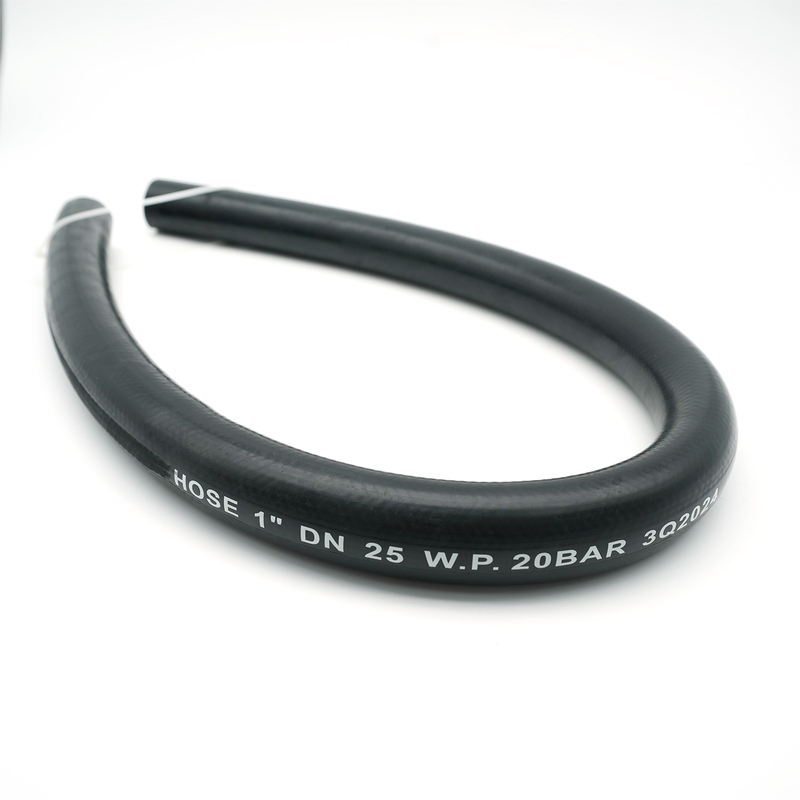
The correct product depends on whether the application involves tanker truck fuel transfer, general oil suction and discharge, or fuel discharge only.
Product | Construction | Application Focus | Key Selection Point |
|---|---|---|---|
NBR tube, synthetic fabric, steel wire helix, anti-static wire | Petroleum fuel suction and discharge for tank trucks | Check fuel compatibility, pressure, vacuum, and available size | |
NBR tube, textile fabric, steel wire helix | Oil suction and discharge in tank trucks and industrial systems | Confirm the required vacuum rating and exact medium | |
NBR tube, synthetic yarn reinforcement | Discharge of compatible petroleum-based products | Confirm that the application does not require suction service |
These products have different constructions and intended applications. Do not select a hose based on its name alone. Review the product specification and confirm suitability for the actual operating conditions.
Choosing a fuel suction and discharge hose for tanker trucks requires more than checking the hose diameter or working pressure. Buyers must consider fuel compatibility, inner tube material, reinforcement, vacuum resistance, hose length, fittings, and static control.
A hose with a steel wire helix is important for suction service, but its vacuum rating must still match the system. The complete hose assembly must also meet the required pressure, connection, and safety conditions.
Honestflex offers tank truck oil hoses and oil suction and discharge hoses for different petroleum transfer applications. Contact Honestflex with your fuel type, flow requirements, operating pressure, vacuum conditions, and connection details to identify a suitable hose.
A fuel suction and discharge hose is designed to transfer compatible petroleum products under both negative-pressure suction and positive-pressure discharge conditions. Its construction and ratings must be suitable for both operating modes.
A steel wire helix supports the hose wall and helps prevent collapse under vacuum conditions. The hose must still have a confirmed vacuum rating for the intended application.
NBR rubber is commonly used because it resists many petroleum-based products. However, compatibility depends on the exact fuel composition and operating conditions.
Select the inner diameter according to the required flow rate, pump capacity, suction or discharge conditions, hose length, and connection size. Confirm the selection with the pump and hose manufacturers.
Yes, if it is specifically designed and rated for both conditions. Check the working pressure and vacuum rating before using the hose in a dual-purpose application.
