


T: +86-19511798062
E: sales@honestflex.com
E: sales@honestflex.com
Licang District, Qingdao, Shandong, China
Views: 0 Author: Site Editor Publish Time: 2026-08-18 Origin: Site


In high-pressure hydraulic systems, specifying the wrong spiral wire hose leads to catastrophic blowouts, equipment downtime, and severe safety hazards. Engineering and procurement teams frequently struggle to balance pressure requirements, routing constraints, physical weight, and budget when choosing between DIN EN 856 4SP and 4SH hoses. Making the wrong choice often results in premature fatigue failure or unnecessary expenditure on over-engineered components. You need a clear understanding of how these hoses behave in the field, not just on a spec sheet. This guide provides an evidence-based breakdown of the structural differences, performance metrics, and application criteria. We examine metallurgical variations, bend radius physics, and installation realities to help technical buyers confidently evaluate and specify the correct 4SH vs 4SP hydraulic hose for their systems.

Reinforcement Strength: 4SH utilizes extra high-strength steel wire compared to the standard high-strength wire in 4SP, allowing for significantly higher working pressures.
Size Availability: 4SP is manufactured across a broader range of diameters (small to large), whereas 4SH is exclusively engineered for medium-to-large diameter applications.
Routing Flexibility vs. Stiffness: While 4SH frequently offers a tighter minimum bend radius than 4SP at equivalent internal diameters, its extra-tensile wire makes it physically stiffer and harder to bend during installation.
Implementation Reality: Both hoses require precise fitting selection and skiving; they are not universally interchangeable without reviewing specific system pressure spikes, impulse cycles, and spatial constraints.
Table of Contents
The DIN EN 856 standard dictates the manufacturing, testing, and performance requirements for rubber hoses reinforced with steel wire spirals. This specification ensures global uniformity for heavy-duty, high-pressure hydraulic lines. Equipment manufacturers rely on this standard to guarantee that replacement parts meet strict safety and operational thresholds regardless of the brand. When you pull a hose off a machine in the field, seeing the EN 856 stamp tells you exactly what baseline performance you can expect.
Spiral construction differs fundamentally from braided construction. Braided hoses, such as those meeting EN 853 standards, feature interwoven steel wires. Under high-impulse cycling, these interwoven wires rub against each other. This friction generates heat and causes the wires to shear, leading to premature hose failure. Spiral hoses eliminate these crossover points. The wires wrap parallel to one another in alternating layers, separated by thin layers of synthetic rubber. This design absorbs massive pressure spikes without internal wire friction.
Braided hoses typically fail in high-impulse environments due to several specific mechanical breakdowns:
Wire crossover friction causes localized heating, degrading the surrounding elastomer.
Repeated expansion and contraction shear the interwoven wires at their intersection points.
Pressure spikes force the braided matrix to expand unevenly, creating weak spots in the outer cover.
Fluid bypasses the damaged inner tube and travels along the broken wire paths, causing cover blisters.
Within the EN 856 standard, 4SP and 4SH represent two distinct performance tiers. The designation 4SP stands for four-spiral standard pressure, though it handles medium-to-high pressure applications perfectly well. The 4SH designation stands for four-spiral super high pressure. Both utilize four layers of spiraled wire, but their internal engineering targets entirely different operational limits. You cannot treat them as identical components just because they both have four wires.

The primary structural distinction lies in the metallurgy of the reinforcement wire. A 4SP hose incorporates four layers of spiraled high-tensile steel wire. This provides excellent burst resistance for standard heavy machinery. In contrast, a 4SH hose utilizes four layers of extra high-tensile steel wire. The carbon content and drawing process of the 4SH wire yield a significantly higher yield strength. When you cut a 4SH hose with a friction saw in the shop, you immediately feel the difference in the wire density and hardness compared to 4SP.
This structural variance directly impacts overall hose rigidity and impulse fatigue resistance. The extra high-tensile wire in 4SH prevents the hose from expanding under extreme pressure spikes. It contains the hydraulic fluid force more effectively, translating to higher burst resistance. However, this stronger wire also dictates how the hose behaves during installation and operation. The wire does not stretch easily, meaning the hose fights back when you try to manipulate it into tight spaces.
Because 4SH uses thicker, higher-tensile wire, it requires more robust elastomer layers to bond the spirals together. This results in a thicker wall and a larger overall outer diameter compared to a 4SP hose of the exact same internal diameter. When routing multiple hoses through a single bulkhead, boom arm, or protective nylon sleeve, this difference in OD becomes a major spatial factor. You might fit four 1-inch 4SP hoses through a specific clamp, but only three 1-inch 4SH hoses will fit in that same space.
Physical Dimensions and Weight Comparison
Internal Diameter (Inch) | Dash Size | 4SP Nominal OD (mm) | 4SH Nominal OD (mm) | 4SP Weight (kg/m) | 4SH Weight (kg/m) |
|---|---|---|---|---|---|
3/4" | -12 | 32.2 | 32.2 | 1.50 | 1.55 |
1" | -16 | 39.7 | 38.7 | 2.00 | 2.05 |
1.25" | -20 | 50.8 | 45.5 | 3.10 | 2.45 |
1.5" | -24 | 57.2 | 53.5 | 3.80 | 3.30 |
Note: Dimensional data varies slightly by manufacturer, but the structural trend remains consistent across EN 856 certified products.
The denser wire and thicker rubber walls make 4SH noticeably heavier in larger sizes. Weight implications matter significantly in mobile equipment design. A heavy excavator boom utilizing dozens of feet of 4SH hose will carry more static weight than one using 4SP. This added weight increases physical fatigue for technicians during installation. Maneuvering and supporting heavy 4SH assemblies requires more physical effort, stronger clamping mechanisms, and often two technicians instead of one.
Manufacturing limitations dictate the available sizes for each hose type. 4SP is typically available in a broad range of internal diameters, spanning from 1/4 inch up to 2 inches. This versatility makes it suitable for both small pilot lines and large return lines. You can plumb an entire medium-duty machine using different sizes of 4SP.
Conversely, 4SH is generally restricted to medium-to-large diameters, typically ranging from 3/4 inch to 2 inches. Engineering a 1/4 inch 4SH hose is highly impractical. The extra high-tensile wire required for the 4SH specification would make a small-diameter hose completely inflexible. It would behave more like a solid steel pipe than a flexible routing component. Systems requiring extreme pressure in very small diameters usually rely on alternative hose specifications rather than attempting to force 4SH into a tiny footprint.
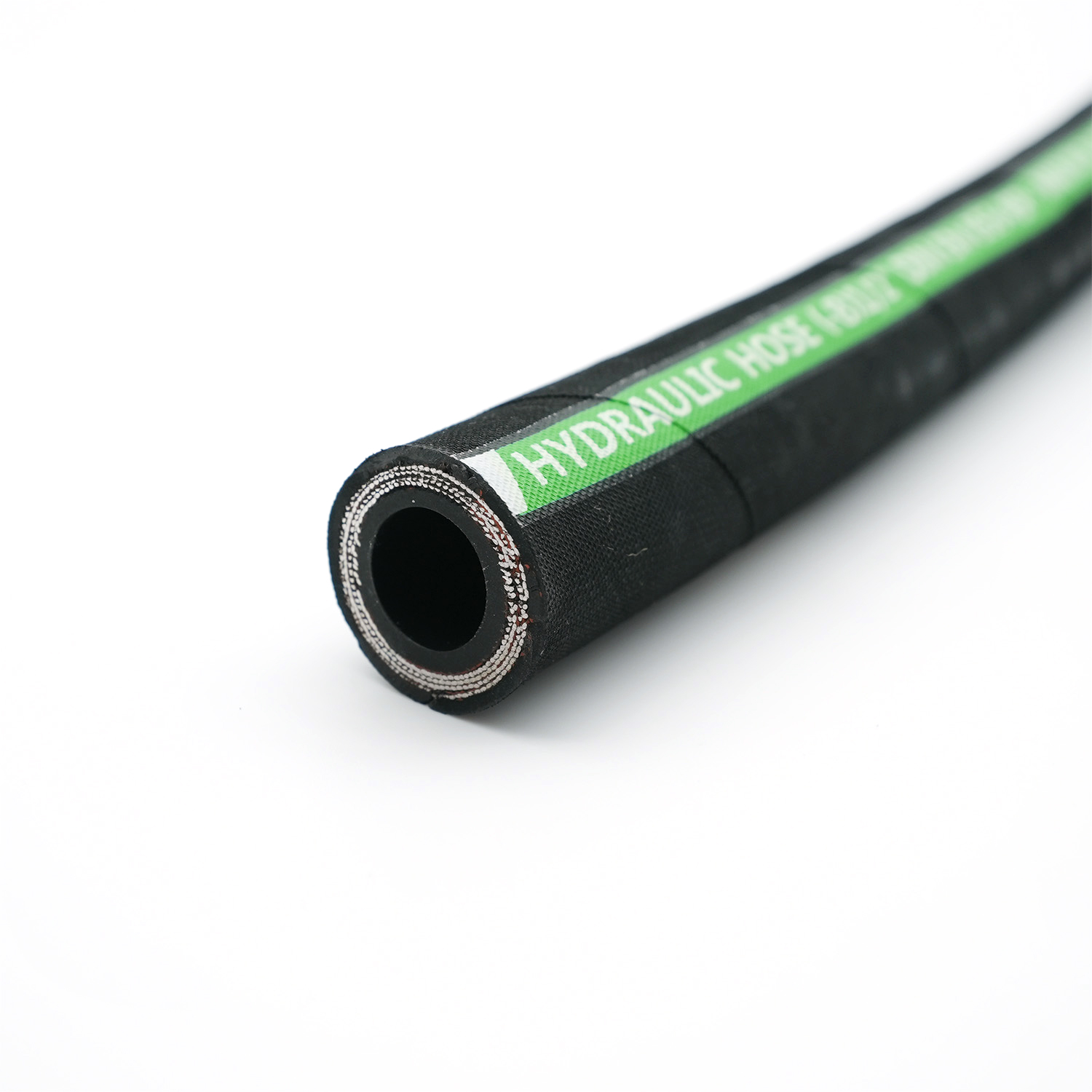
The defining performance metric for any hydraulic hose is its maximum working pressure. Due to its extra high-tensile wire, 4SH significantly outperforms 4SP in this category. The EN 856 standard mandates a strict 4:1 safety factor for both hoses. This means the theoretical burst pressure must be at least four times the stated maximum working pressure. If a hose is rated for 400 bar working pressure, it must not burst until it hits at least 1600 bar during static laboratory testing.
Comparative Pressure Ratings for EN 856 Hoses
Internal Diameter (Inch) | 4SP Max Working Pressure (Bar) | 4SP Min Burst Pressure (Bar) | 4SH Max Working Pressure (Bar) | 4SH Min Burst Pressure (Bar) |
|---|---|---|---|---|
3/4" | 350 | 1400 | 420 | 1680 |
1" | 280 | 1120 | 380 | 1520 |
1.25" | 210 | 840 | 350 | 1400 |
1.5" | 185 | 740 | 290 | 1160 |
2" | 165 | 660 | 250 | 1000 |
As the internal diameter increases, the maximum working pressure naturally decreases for both hose types. The larger surface area inside the hose amplifies the total outward force exerted by the fluid. 4SH maintains a much higher pressure rating across all shared sizes, making it mandatory for heavy-duty hydrostatic drives where pressures routinely spike above 350 bar.
Engineers often confuse minimum bend radius with physical flexibility. The minimum bend radius is a geometric limit. It defines how tightly a hose can be bent before it kinks, flattens, or suffers structural damage to the wire reinforcement. 4SH, despite handling higher pressures, often achieves a smaller minimum bend radius than 4SP at equivalent sizes. The extra-tensile wire provides superior structural integrity, preventing the hose wall from collapsing inward during a tight bend.
Flexibility, or stiffness, refers to the physical force required to achieve that bend. While 4SH can bend tighter geometrically, it is significantly stiffer. Technicians must apply substantial physical force to bend a 4SH hose into its minimum radius. 4SP is much easier to manipulate by hand. This stiffness impacts routing in tight engine compartments. Forcing a stiff 4SH hose into position places heavy stress on the end fittings if you do not measure and clamp it correctly.
Hydraulic systems rarely operate at a constant static pressure. Valves open and close rapidly, cylinders hit dead stops, and loads shift abruptly. These actions create shockwaves known as the water hammer effect. These pressure spikes test the impulse fatigue resistance of the hose. EN 856 testing criteria require spiral hoses to survive hundreds of thousands of impulse cycles at elevated temperatures and pressures exceeding their standard rating.
During an impulse test, the hose is subjected to a pressure square wave. The pressure shoots up to 133% of the maximum working pressure, holds briefly, and drops back to zero. This happens roughly one time per second. Both 4SP and 4SH excel in these high-impulse environments compared to braided hoses. However, 4SH is specifically engineered to absorb extreme shock loads without wire fatigue. In applications like rock crushers or excavators breaking hard ground, the pressure spikes easily exceed the limits of 4SP. The extra high-tensile wire in 4SH prevents the micro-expansions that eventually lead to wire fatigue and hose rupture.
Standard EN 856 temperature ratings for both 4SP and 4SH typically range from -40°C to +100°C. They handle intermittent peaks up to 120°C. Operating continuously at peak temperatures accelerates the degradation of the synthetic rubber. The heat bakes the plasticizers out of the elastomer, hardening the inner tube and outer cover until they become brittle and crack. Once the inner tube cracks, high-pressure fluid reaches the steel wire, leading to rapid corrosion and eventual blowout.
Extreme environments dictate outer cover selection regardless of the internal wire specification. Mining applications require MSHA-approved covers for fire resistance. High-friction environments demand ultra-high abrasion-resistant covers made from UHMWPE (Ultra-High-Molecular-Weight Polyethylene). While the internal wire dictates pressure capability, the outer cover ensures the hose survives environmental hazards like rock impacts, UV exposure, and ozone degradation.

4SP serves as the workhorse for medium-to-heavy industrial and mobile hydraulics. It provides excellent spiral wire durability without the extreme stiffness and weight of 4SH. Specify 4SP for general industrial hydraulics, agricultural machinery, and medium-heavy equipment where pressure demands remain within standard 4-spiral limits.
It is the optimal choice when smaller internal diameters (under 3/4 inch) require spiral reinforcement. 4SP is also preferred when routing requires a lighter, easier-to-handle hose. Technicians install 4SP much faster in complex manifolds due to its lower physical resistance to bending. Common applications include tractor implements, standard injection molding machines, auxiliary hydraulic circuits, and forklift mast lines.
4SH is mandatory for applications generating extreme pressure and severe shock loads. Specify 4SH for heavy earthmoving equipment like large excavators, articulated dump trucks, and wheel loaders. It is the standard for mining machinery, hydrostatic transmissions, and high-shock load environments like hydraulic presses and scrap shears.
Select 4SH when space constraints demand a tight bend radius without sacrificing extreme high-pressure capabilities. The superior burst resistance ensures safety and reliability in critical main drive lines. If an equipment schematic calls for 4SH, substituting it with 4SP will almost certainly lead to premature failure and potential safety hazards under peak load conditions. You cannot cheat the physics of a hydrostatic drive circuit; it will find the weak point in a 4SP hose and blow it apart.
Procurement teams immediately notice the cost differential between the two hoses. 4SH is inherently more expensive to manufacture. The extra high-tensile steel wire costs more, and the heavier construction requires more raw materials and slower extrusion processes. The initial purchase price of a 4SH assembly will always exceed that of an equivalent 4SP assembly.
Value must be calculated based on lifecycle and downtime prevention. Paying a premium for 4SH prevents costly downtime in extreme-pressure mining applications. A single blown hose on a primary excavator halts an entire job site, costing thousands of dollars per hour in lost production. In these scenarios, the higher initial cost of 4SH delivers a massive return on investment. Conversely, using 4SH on a standard agricultural tractor is an unnecessary expense. 4SP provides the exact same lifespan in standard conditions at a fraction of the cost.
Many maintenance facilities attempt to standardize inventory to reduce SKU counts. A common question is whether a facility can stock only 4SH to cover all 4SP applications. While technically possible—since 4SH exceeds the pressure ratings of 4SP—it is rarely a sound strategy in practice.
Standardizing exclusively on 4SH introduces several negative factors. First, it drives up routine maintenance costs by using expensive, over-engineered hoses for low-pressure tasks. Second, it adds unnecessary weight to mobile equipment. Third, the extreme stiffness of 4SH frustrates technicians trying to route hoses in tight spaces where 4SP would easily fit. Facilities should maintain stock of both hoses, applying each strictly according to the equipment manufacturer's pressure specifications.
Mixing and matching fittings is a critical safety hazard. 4SP and 4SH require specific, compatible high-pressure fittings. Because of its extreme pressure rating, 4SH almost exclusively requires interlock fittings. These fittings are designed to bite directly into the steel wire reinforcement to prevent blow-off under heavy load. Standard crimp fittings rely on compressing the rubber; interlock fittings rely on metal-to-metal mechanical locking.
Achieving this secure connection requires precise skiving. Skiving is the process of removing the rubber layers to expose the wire. 4SP typically requires only external skiving (removing the outer cover). 4SH frequently requires both external and internal skiving. Internal skiving removes a portion of the inner rubber tube, allowing the fitting insert to grip the wire from the inside while the ferrule grips it from the outside.
The internal and external skiving process involves strict steps:
Measure the exact insertion depth required by the specific interlock fitting.
Set the external skiving tool to remove the outer rubber cover without nicking the top layer of steel wire.
Set the internal skiving tool to remove the inner rubber tube to the exact depth specified by the manufacturer.
Clean all rubber dust and debris from the exposed wire and the inside of the hose tube.
Slide the ferrule over the externally skived section.
Insert the fitting stem into the internally skived section until it bottoms out.
Crimp the assembly to the exact diameter specified by the fitting manufacturer's crimp chart.
Improper skiving depth or length is the leading cause of catastrophic fitting blow-off. Technicians must use calibrated skiving tools and follow exact manufacturer crimp specifications. Guessing the crimp diameter on a 4SH hose is a guaranteed way to cause a failure.
The stiffness of 4SH makes it particularly susceptible to installation errors. The most dangerous error is twisting the hose during installation. Applying torque to a spiral hose degrades the wire integrity and reduces burst pressure capacity by up to 70%. When you twist a spiral hose, you force the outer layers of wire to expand and the inner layers to compress, destroying the parallel structure.
Technicians must use the printed layline on the hose cover as a visual guide. If the layline spirals around the hose after tightening the fittings, the hose is twisted. You must loosen the fitting, straighten the hose, and retighten it using two wrenches—one to hold the hose end straight, and one to turn the swivel nut.
Follow these routing best practices to mitigate installation hazards:
Use proper clamping at regular intervals to support the heavy weight of 4SH assemblies.
Adhere strictly to minimum bend radius charts; never force a hose to bend tighter than its geometric limit.
Utilize swivel fittings or angled adapters (like 45-degree or 90-degree blocks) to relieve stress if a routing path requires a tight bend right at the connection point.
Leave enough slack in the hose to accommodate the 2% to 4% length change that occurs when the hose pressurizes.
Route hoses away from exhaust manifolds or use fire-sleeve protection to prevent heat degradation.
Consult your equipment's hydraulic schematics to identify the exact maximum working pressures and impulse spike potentials in your system.
Review EN 856 pressure charts to match your required internal diameter with the appropriate 4SP or 4SH working pressure rating.
Evaluate the physical routing path on the machine to determine if the stiffness and weight of 4SH will cause installation issues or require angled adapters.
Verify that your shop has the correct internal and external skiving tools and interlock fittings required for 4SH assemblies.
Contact a certified hose supplier for technical specification assistance and custom assembly quotes to ensure perfect fitting compatibility.
Reliable Hydraulic Hose Manufacturing Support
Qingdao Honest Rubber Co., Ltd, operating under the Honestflex brand, is a professional manufacturer and exporter of hydraulic hoses, industrial hoses, PVC hoses, hose couplings, and hose protection products, supported by a 20,000-square-meter workshop and 108 sets of production and testing equipment.
With experienced technical and export teams, Honestflex provides manufacturing and product support for customers seeking reliable hose solutions for different pressure levels, equipment types, and industrial operating conditions.
A: 4SH utilizes extra high-tensile steel wire, allowing it to handle significantly higher maximum working pressures and extreme pressure spikes compared to 4SP. 4SP uses standard high-tensile wire and is rated for medium-to-high pressure applications.
A: No. 4SH hoses require specific, heavy-duty fittings, often interlock style, designed to handle extreme pressures. Using standard 4SP fittings on a 4SH hose will likely result in fitting blow-off and catastrophic failure.
A: Geometrically, 4SH often achieves a tighter minimum bend radius than 4SP because its stronger wire prevents collapsing. However, 4SH is physically much stiffer and requires significantly more force to bend into that radius.
A: Yes. The extra high-tensile wire and thicker rubber layers required for 4SH make it noticeably heavier, thicker, and much stiffer to bend during installation than a 4SP hose of the same internal diameter.
A: Yes, both require skiving for secure fitting attachment. 4SP typically requires only external skiving. 4SH often requires both external and internal skiving to accommodate high-pressure interlock fittings.
A: The extra high-tensile steel wire required for the 4SH specification makes a small-diameter hose completely inflexible. It behaves like a rigid pipe, defeating the purpose of a flexible hydraulic hose.
