


T: +86-19511798062
E: sales@honestflex.com
E: sales@honestflex.com
Licang District, Qingdao, Shandong, China
Views: 0 Author: Site Editor Publish Time: 2026-08-18 Origin: Site


Premature hydraulic hose failure rarely stems from a manufacturing defect. It almost always results from incorrect specification at the engineering and procurement level. System designers and maintenance engineers constantly balance maximum working pressure requirements against routing complexity, weight limitations, and physical constraints. Selecting the wrong reinforcement layer configuration leads to either catastrophic bursts from under-speccing or unnecessary rigidity from over-speccing. You cannot afford to guess when dealing with high-pressure fluid power.
To ensure system reliability and safety, this guide provides a technical breakdown of the EN 853 standard. We evaluate construction, performance thresholds, and optimal industrial applications to drive accurate procurement decisions. Understanding the exact differences between a 1SN vs 2SN hydraulic hose prevents equipment failure and ensures optimal fluid power transmission across your entire fleet.

Reinforcement Architecture: The primary distinction lies in the reinforcement layer; 1SN utilizes a single layer of high-tensile steel wire braid, while 2SN utilizes two layers, directly impacting pressure tolerance and rigidity.
Pressure vs. Flexibility Trade-off: 2SN hoses handle significantly higher working pressures (ranging from 2,300 psi up to 5,800 psi / 400 bar in smaller diameters) but sacrifice the tight bend radius and superior flexibility offered by 1SN hoses (which max out around 3,625 psi / 250 bar).
Application Specificity: 1SN is optimal for medium-pressure hydraulic systems with complex, tight-space routing, whereas 2SN is required for high-pressure heavy machinery, construction equipment, and high-pressure water/sewer cleaning applications.
Implementation Reality: Both 1SN and 2SN are "no-skive" compatible by design (the "SN" designation), but verifying exact ferrule and fitting compatibility remains critical to prevent blow-offs.
Table of Contents
The European Norm (EN) 853 standard dictates strict manufacturing requirements for wire-braided hydraulic hoses. You will often see this standard used interchangeably with DIN EN 853 in technical schematics. It governs material composition, structural integrity, testing protocols, and dimensional tolerances. Manufacturers must adhere to these specifications to ensure consistent performance across global fluid power systems. The standard provides a reliable baseline for engineers designing hydraulic circuits, ensuring that a hose bought in one country performs identically to one bought in another.
The "SN" designation stands for "Standard No-skive." This indicates a highly controlled outer cover thickness. Assembly technicians can attach standard fittings without removing the outer rubber cover. If you have ever tried skiving a hose in the field covered in mud and hydraulic oil, you know it is a miserable process. Skiving requires specialized equipment, adds assembly time, and introduces the risk of damaging the steel wire reinforcement during preparation. No-skive hoses streamline the fabrication process and improve overall assembly efficiency on the job site.
Both 1SN and 2SN hoses share identical baseline materials. The inner tube consists of oil-resistant synthetic rubber, typically Nitrile (NBR). This material prevents degradation from petroleum-based fluids. The outer cover uses abrasion, ozone, and weather-resistant synthetic rubber, often Neoprene (CR) or a similar synthetic blend. This protects the internal steel braids from environmental damage, UV exposure, and physical scraping against machine chassis. The shared material science ensures consistent chemical compatibility across both hose types.
Fluid and temperature compatibility remain identical for both configurations. These hoses operate safely within a standard temperature range of -40°C to +100°C. They can handle intermittent temperature peaks up to 120°C without melting the inner tube. They are fully compatible with petroleum-based hydraulic fluids, which make up the vast majority of industrial applications. They also handle water-emulsions and various synthetic fluids. This broad compatibility makes them versatile components in diverse industrial environments.
EN 853 Material Specifications
Component | Standard Material | Primary Function |
|---|---|---|
Inner Tube | Nitrile (NBR) Synthetic Rubber | Contains fluid, resists oil degradation, maintains flow. |
Reinforcement | High-Tensile Steel Wire | Provides structural strength, prevents bursting under pressure. |
Outer Cover | Neoprene (CR) / Synthetic Blend | Protects against abrasion, ozone, UV rays, and weather. |
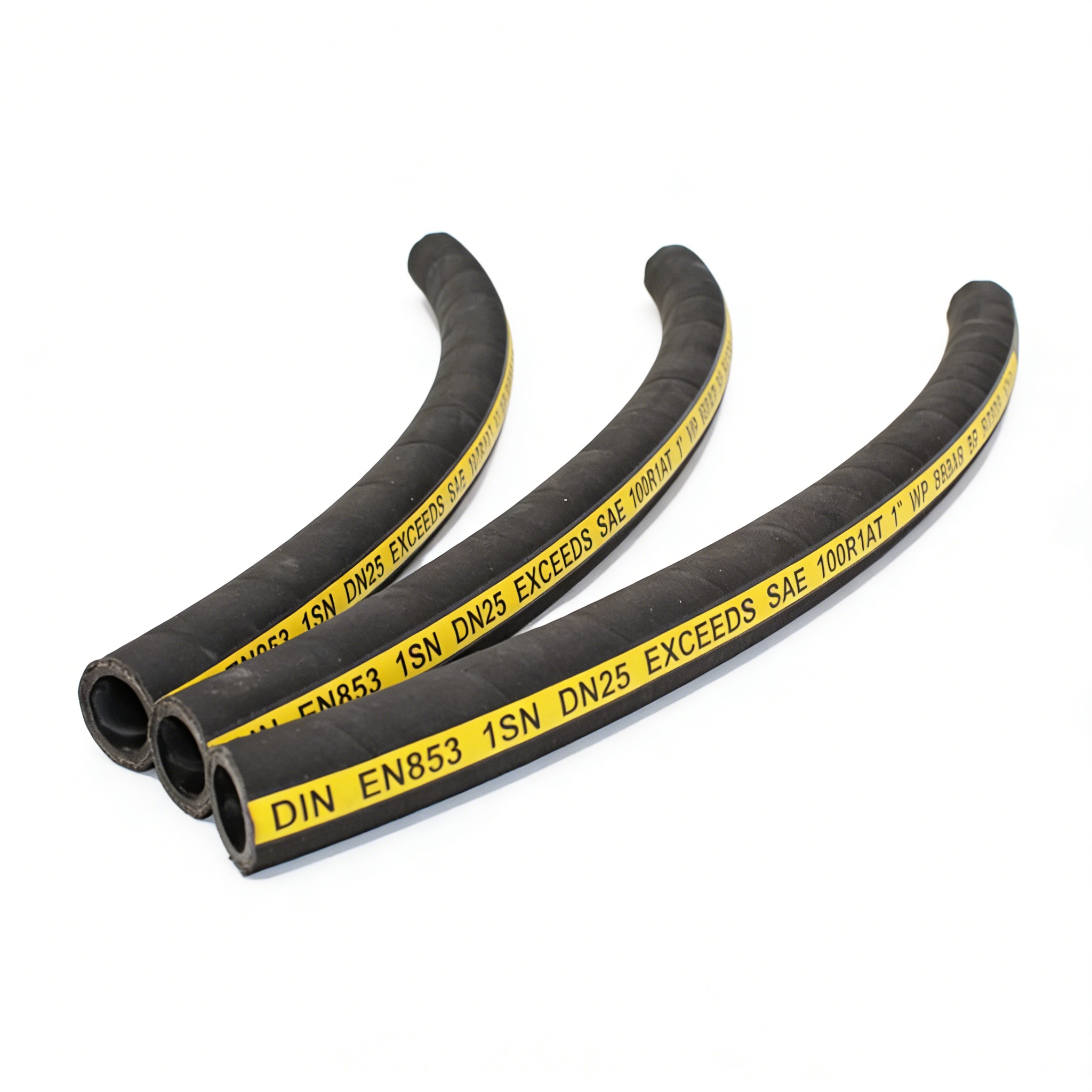
The 1SN hose utilizes a single layer of high-tensile steel wire braid. This braid sits tightly over the synthetic rubber inner tube. Braiding machines weave the steel wires at a specific pitch angle during manufacturing. This angle minimizes volumetric expansion under pressure. When fluid hits the line, the hose wants to swell. The single layer of steel wire locks the rubber in place, providing substantial burst protection while maintaining a thin profile. The wire acts as the primary load-bearing component of the hose.
This single braid directly impacts the physical dimensions of the hose. It results in a smaller Outer Diameter (OD) compared to multi-layer hoses. The overall weight per meter is significantly lower. This weight reduction benefits mobile equipment design, where every extra pound affects fuel efficiency and payload capacity. The thinner wall allows for easier manipulation during installation. Technicians can route these hoses through narrow bulkheads, tight engine compartments, and complex manifold blocks with minimal effort.
Engineers specify 1SN for medium-pressure environments. Space constraints often dictate component selection in modern machinery. The need for superior flexibility makes 1SN highly desirable. It easily accommodates dynamic movements in articulated machine joints. Think of the steering cylinders on a small tractor or the return lines on a hydraulic press. The single braid architecture perfectly balances pressure containment with physical agility.
The 2SN hose features a dual-layer high-tensile steel wire braid construction. A thin rubber friction layer separates the two steel braids. This isolation layer is absolutely critical. Without it, the steel wires would rub against each other during pressure cycles, creating friction that would eventually snap the wires. The inner braid handles the primary outward radial force from the fluid. The outer braid provides secondary reinforcement and structural stability. This dual-layer approach exponentially increases the burst threshold.
This robust construction alters the dimensional footprint of the hose. The wall thickness increases noticeably. The larger OD requires different clamping and routing strategies. You cannot use the same clamps for a 1/2-inch 1SN hose on a 1/2-inch 2SN hose; the 2SN simply will not fit. The weight per meter increases due to the additional steel mass. These physical changes require careful consideration during the system design phase. The added bulk complicates installation in confined spaces and requires mechanics to use more physical force during routing.
The 2SN configuration serves as the heavy-duty standard for fluid power. It excels in high-pressure impulse applications. Heavy machinery requires maximum burst resistance to keep operators safe. The structural rigidity prevents expansion under extreme load. Engineers rely on 2SN when system safety margins demand uncompromising strength. When a machine lifts a 10-ton concrete barrier, the hydraulic lines holding that weight must not fail. 2SN provides that guarantee.
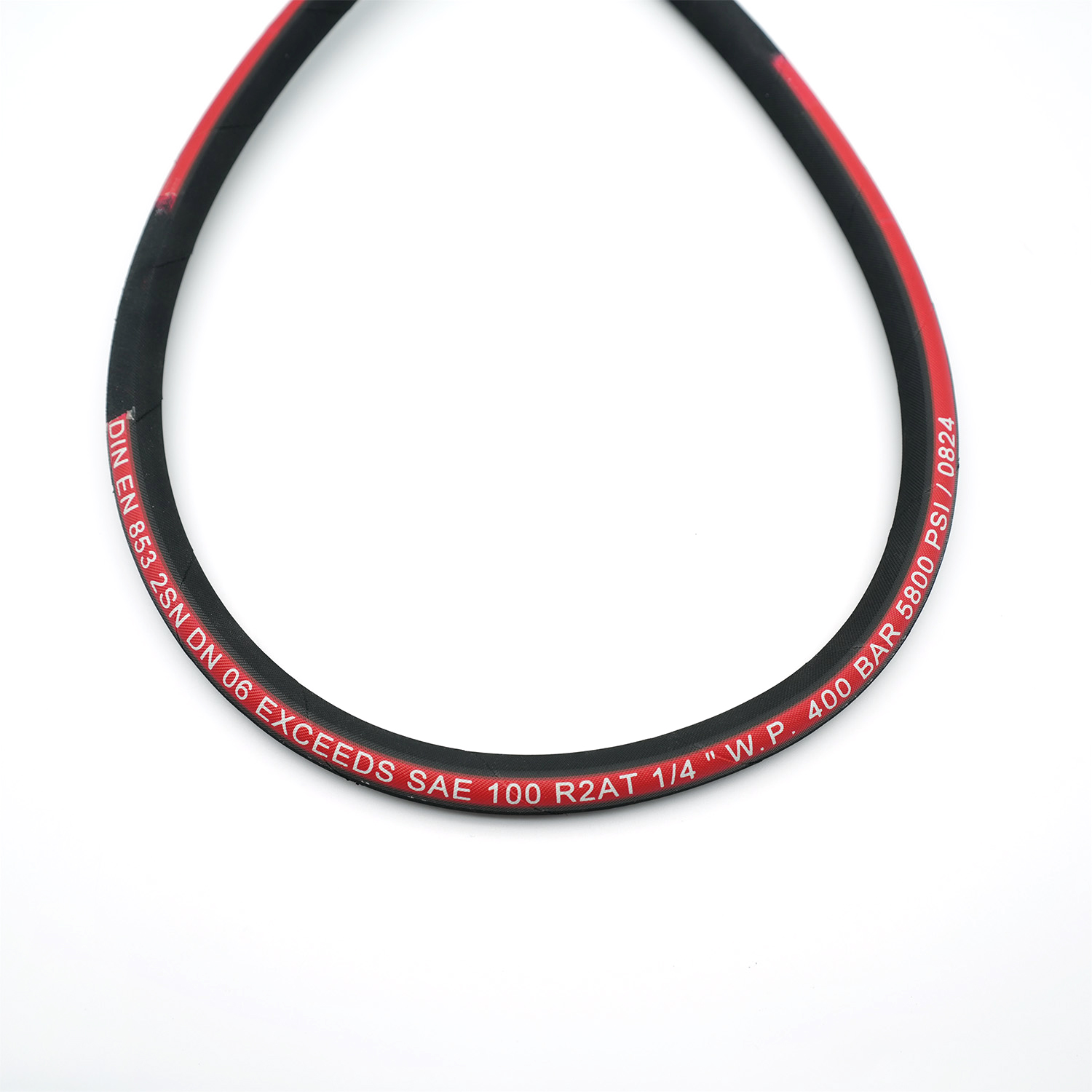
Working pressure capabilities define the primary difference between these hoses. A 1/4-inch 1SN hose maxes out at approximately 3,625 psi (250 bar). A 1/4-inch 2SN hose reaches up to 5,800 psi (400 bar). This pressure gap remains consistent across larger internal diameters. As the internal diameter increases, the maximum working pressure decreases for both types. This inverse relationship is a fundamental principle of fluid dynamics. A larger surface area inside the hose means the fluid exerts more total outward force against the walls.
EN 853 mandates a strict 4:1 burst-to-working pressure safety ratio. If a hose has a working pressure of 3,000 psi, it must withstand 12,000 psi before bursting in a laboratory setting. Both 1SN and 2SN adhere to this critical safety factor. This margin protects operators from sudden pressure surges. It ensures the hose will not fail catastrophically under normal operating conditions. You never want to run a hose at its absolute maximum rating continuously; the 4:1 ratio provides the necessary buffer.
System designers must calculate potential pressure spikes. These spikes, known as impulse pressures, occur during rapid valve closures or sudden mechanical impacts. The water hammer effect can temporarily double the system pressure in a fraction of a second. Engineers must determine if a 1SN hose can absorb these spikes safely. If the impulse pressure exceeds the 1SN rating, a 2SN upgrade becomes mandatory. Ignoring impulse spikes is the fastest way to blow a hose off a machine.
Working Pressure Comparison by Hose Size
Dash Size | Inch Size | 1SN Max Working Pressure (psi) | 2SN Max Working Pressure (psi) |
|---|---|---|---|
-04 | 1/4" | 3,625 | 5,800 |
-06 | 3/8" | 2,610 | 4,785 |
-08 | 1/2" | 2,320 | 4,000 |
-12 | 3/4" | 1,525 | 3,115 |
-16 | 1" | 1,275 | 2,400 |
Flexibility metrics heavily influence hose selection. The minimum bend radius dictates how tightly a hose can curve without kinking or damaging the wire braid. 1SN hoses offer a significantly tighter bend radius. This superior flexibility allows for compact system design. Technicians can route 1SN hoses through complex, winding paths. The single braid stretches on the outside of the curve and compresses on the inside easily during bending.
The increased rigidity of 2SN hoses presents routing challenges. Forcing a 2SN hose into a tight path causes severe mechanical stress. It can lead to kinking, which restricts fluid flow and creates a massive heat buildup at the kink point. It can cause the outer cover to tear, exposing the steel wire to rust. Bending stress also transfers directly to the metal fittings, risking premature failure at the crimp joint. 2SN hoses require sweeping, gradual curves to function correctly.
Assessing the physical footprint of the hydraulic system is critical. Engineers must measure the available space for hose routing before specifying the hose type. If the design requires sharp turns right out of a pump manifold, 1SN is often the only viable option. If space permits large sweeping bends along a boom arm, 2SN can be utilized. The physical environment directly dictates the reinforcement selection just as much as the pressure requirements do.
System weight impacts overall machine efficiency. The weight difference between 1SN and 2SN scales rapidly in large machinery. Agricultural equipment, mobile cranes, and forestry processors utilize extensive hydraulic networks containing hundreds of feet of hose. Using 2SN throughout a machine adds unnecessary mass. This extra weight reduces fuel efficiency, slows down boom movements, and alters the center of gravity. 1SN helps keep mobile equipment light and agile.
Clearance issues arise from the larger OD of 2SN hoses. Bundling multiple 2SN hoses together requires larger clamps and more physical space on the machine frame. Routing them through protective sleeves or steel bulkheads demands wider openings. The increased friction between thick hoses rubbing against each other can cause external wear. System designers must account for these dimensional differences early in the drafting process to avoid assembly nightmares on the production floor.
Cover wear mechanisms differ between the two hose types. The rubber cover material is identical. However, the stiffer 2SN hose experiences different friction points. In dynamic applications, its resistance to bending causes it to rub harder against adjacent surfaces. 1SN flexes with the machine movement, often reducing localized abrasion because it yields to the physical contact. Proper sleeving, like nylon burst sleeves or spiral plastic wrap, is recommended for both types in high-friction zones.
Fatigue resistance is measured through impulse cycle testing. Hoses undergo continuous pressure fluctuations to simulate real-world use. 2SN hoses generally exhibit longer impulse life under high-stress conditions. The dual braids distribute the fatigue load more evenly across the hose structure. 1SN hoses perform exceptionally well within their rated limits but fatigue faster if subjected to constant, aggressive pressure spikes near their maximum threshold.

Medium-pressure hydraulic systems rely heavily on 1SN hoses. Machine tools use them for fluid transport, lubrication lines, and coolant delivery. They function perfectly as return lines where pressure is minimal, simply carrying fluid back to the reservoir. Pilot lines, which transmit low-pressure control signals to larger valves, also utilize 1SN. The pressure in these specific circuits rarely challenges the single-braid threshold, making 1SN the most efficient choice.
Mobile equipment manufacturers favor 1SN for specific functions. Forklifts use them for mast articulation and side-shifting mechanisms where hoses must roll over sheaves continuously. Light agricultural attachments depend on their flexibility to connect and disconnect easily from tractor remotes. Any system requiring complex articulation benefits from the single-braid design. The hose moves seamlessly with the mechanical components without fighting the machine's natural motion.
Success with 1SN depends on specific criteria. We choose it when flexibility and weight reduction outweigh extreme pressure needs. Engineers prioritize 1SN when designing compact, agile machinery. It provides the necessary fluid power without over-encumbering the physical structure. If you are plumbing a small skid steer attachment, 1SN gives you the routing freedom you need to keep the lines protected and out of the dirt.
High-pressure hydraulics demand the robust construction of 2SN hoses. Excavators use them for main boom, stick, and bucket cylinder actuation. Mining equipment relies on them to crush rock and move heavy earth under extreme loads. Heavy lifting machinery, like hydraulic presses and mobile cranes, requires dual-braid stability. These applications generate massive force and continuous pressure spikes that would destroy a single-braid hose in a matter of hours.
Specialized fluid transfer also requires 2SN capabilities. High-pressure water jetting systems use them to cut materials and strip concrete. Sewer cleaning hoses endure harsh environments, dragging across asphalt while holding high internal pressure. General industrial cleaning equipment relies on their burst resistance to protect operators holding the wands. The dual braid ensures safety when handling high-velocity fluids that act like a cutting torch if a leak occurs.
Success with 2SN hinges on non-negotiable performance requirements. We choose it when system pressure spikes are frequent and severe. Heavy load bearing requires maximum burst protection. Engineers specify 2SN when equipment failure could result in severe safety hazards, dropped loads, or massive operational downtime. You do not compromise on main drive lines; you use 2SN and ensure the machine operates safely.
Over-speccing occurs when engineers use 2SN where 1SN is sufficient. This error leads to unnecessary system weight. It makes installation significantly more difficult for technicians. The stiff hoses resist routing and strain the connection points. Mechanics fight the hose to get the threads aligned, often cross-threading fittings in the process. Over-speccing complicates maintenance, adds unnecessary bulk to the machine design, and forces wider bend radii that expose the hose to external damage.
Under-speccing is a critical engineering failure. Using 1SN in a 2SN environment guarantees premature burst failure. The single braid cannot contain the high-pressure spikes. This creates severe safety hazards for operators near the equipment, including the risk of high-pressure fluid injection injuries. It also leads to environmental contamination from spilled hydraulic fluid. Under-speccing compromises the entire fluid power system and guarantees catastrophic downtime.
Ferrule selection is an absolute necessity for safe assembly. Technicians must match the correct ferrule and insert to the specific hose profile. A 1SN ferrule will not properly grip a 2SN hose because the rubber and wire thickness differ. The teeth inside the ferrule are designed to bite through the rubber and lock onto the wire at a specific depth. Mismatched components lead to immediate fitting blow-off under pressure, turning a heavy steel fitting into a deadly projectile.
Crimping specifications differ significantly between the two types. 1SN and 2SN require different final crimp diameters. Using the wrong specification crushes the inner tube, restricting flow and creating heat. Conversely, under-crimping allows the fitting to detach violently. Precision in the crimping process is non-negotiable for system integrity. You cannot guess the crimp diameter; you must measure it.
Risk mitigation relies on strict adherence to manufacturer guidelines. Technicians must consult specific crimp charts for every assembly. Relying on generic dimensional assumptions is dangerous and negligent. Proper training and precise measurement prevent catastrophic assembly failures in the field.
Standard Crimping Procedure
Cut the hose square using a specialized abrasive saw to prevent wire fraying and ensure a flush fit.
Select the exact ferrule designed specifically for either the 1SN or 2SN profile you are using.
Insert the fitting fully into the hose until it bottoms out against the internal tube stop.
Crimp the assembly using the exact die size and setting specified by the manufacturer's crimp chart.
Measure the final crimp diameter with calibrated calipers to verify it matches the specification exactly.
Troubleshooting Common Hose Failures
Failure Mode | Likely Cause | Solution |
|---|---|---|
Fitting Blow-off | Incorrect ferrule or under-crimped assembly. | Verify ferrule compatibility and measure crimp diameter with calipers. |
Hose Burst at Bend | Exceeded minimum bend radius (kinking). | Reroute hose with a wider sweep or switch to a more flexible 1SN hose. |
Cover Abrasion | Hose rubbing against machine chassis or other hoses. | Install nylon protective sleeving or use proper clamping techniques. |
Pinhole Leak | Wire fatigue from excessive pressure spikes. | Upgrade from 1SN to 2SN to handle high impulse pressures. |
Audit your system's maximum operating pressure and calculate potential impulse spikes before selecting a hose reinforcement type.
Measure the available bend radius space in your equipment's routing paths to ensure the hose will fit without kinking or stressing the fittings.
Verify exact fitting and ferrule compatibility with your chosen hose specification using the manufacturer's official crimp charts.
Measure the final crimp diameter with calibrated calipers on every single assembly to confirm it meets safety standards.
As hydraulic systems continue to demand reliable pressure performance, correct hose construction and assembly compatibility remain essential to equipment safety and service life. Qingdao Honest Rubber Co., Ltd, operating under the Honestflex brand, is a professional hydraulic and industrial hose manufacturer and exporter, combining production, testing, and technical capabilities to supply hydraulic hose, fittings, and related hose solutions for customers worldwide.
A: The primary difference is the reinforcement layer. 1SN utilizes a single layer of high-tensile steel wire braid, making it lighter and highly flexible. 2SN features two layers of steel wire braid separated by a rubber friction layer, which increases its weight and rigidity while significantly boosting its maximum working pressure.
A: Pressure ratings depend entirely on the internal diameter. For a 1/4-inch size, a 1SN hose typically handles up to 3,625 psi (250 bar). A 2SN hose of the exact same size handles up to 5,800 psi (400 bar). Both ratings scale down as the hose diameter increases.
A: While a 2SN hose easily handles the lower pressure of a 1SN system, we do not recommend swapping them blindly. The 2SN hose has a larger outer diameter, heavier weight, and a stiffer bend radius. This causes installation difficulties and puts severe stress on fittings in tight spaces.
A: "SN" stands for "Standard No-skive." This designation means the hose's outer rubber cover is manufactured to a specific, controlled thickness. It allows mechanics to crimp standard fittings directly onto the hose without needing to skive, or shave off, the outer rubber cover first.
A: No, both 1SN and 2SN hoses are designed specifically for no-skive assembly. You do not need to remove the outer rubber cover before attaching the fittings. You must always use the correct no-skive ferrules and follow the manufacturer's specific crimp diameter charts to ensure a safe connection.
